

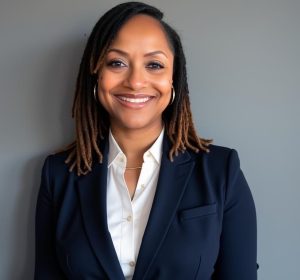
Mia Venson, Founder & Principal Consultant, Pink Moon Consulting
Artificial intelligence is quickly becoming part of how organizations work.
It can help recruiters review information more efficiently. It can support workforce planning, identify patterns in data, draft communications, summarize information, and help leaders think through complex challenges.
The opportunities are significant.
But as AI becomes more embedded in how organizations hire, manage, evaluate, and communicate with people, there is an important question leaders cannot afford to overlook:
Who is accountable for the decision?
The answer should still be us.
AI can provide information.
AI can identify patterns.
AI can make recommendations.
But leadership cannot outsource accountability.
Efficiency Shouldn’t Replace Judgment
Imagine an AI-enabled recruiting tool identifies one candidate as a stronger match than another.
Should the recommendation be considered?
Absolutely.
But someone still needs to ask:
- What information influenced that recommendation?
- Were the right criteria considered?
- Is there relevant experience or context the technology may not have adequately captured?
- Would I be comfortable explaining how this decision was made to the candidate?
The same principle applies beyond recruiting.
A manager may use AI to help organize information before writing a performance review.
An HR leader may use it to identify workforce trends.
A leadership team may use predictive analytics to understand potential retention risks.
AI can make each of those processes more efficient.
But efficiency and accountability are not the same thing.
The more consequential the people decision, the more important thoughtful human judgment becomes.
AI Doesn’t Remove Bias Simply Because It’s Technology
There’s another assumption leaders should challenge: that a technology-supported decision is automatically an objective one.
It isn’t.
AI systems operate based on information, criteria, instructions, and data. Those inputs, and the way organizations choose to use the resulting outputs, matter.
That’s why human oversight shouldn’t be treated as the final checkbox after AI has already reached a conclusion.
It should be part of the process.
Leaders still need to question assumptions.
HR still needs to consider fairness.
Organizations still need to understand how technology is being used in employment decisions.
And someone still needs to take responsibility for the outcome.
“The system recommended it” should never become a substitute for sound leadership judgment.
Accountability Becomes More Important, Not Less
This is where the conversation about AI and accountability becomes especially important.
As technology becomes more capable, it can be tempting to transfer more decision-making authority to the tool.
But perhaps the opposite should happen.
The more powerful our tools become, the more intentional we need to become about how we use them.
That means organizations need clarity around questions such as:
- Where is AI appropriate in our people processes?
- Which decisions always require meaningful human review?
- Who is responsible for reviewing AI-generated recommendations?
- How do we identify and challenge potentially incomplete or problematic outputs?
- Are employees and managers appropriately trained to use these tools?
- Can we explain how important employment decisions are ultimately being made?
Those aren’t simply technology questions.
They’re leadership questions.
Keep the ‘Human’ in Human Resources
There is tremendous opportunity for HR leaders who learn how to use AI well.
AI can give us more time.
It can help us find information faster.
It can uncover insights we might otherwise miss.
It can reduce administrative work and create capacity for more strategic thinking.
But perhaps the greatest opportunity isn’t replacing what humans do.
It’s allowing humans to spend more time doing what technology cannot do particularly well on its own:
Understanding context.
Exercising judgment.
Building trust.
Having difficult conversations.
Recognizing nuance.
Leading with empathy.
And taking responsibility.
That’s where leadership still matters.
The Pink Moon Perspective
The future of HR doesn’t need to be human versus AI.
It can be human judgment strengthened by AI.
Organizations should embrace technology that helps their people work smarter and make better-informed decisions.
But innovation shouldn’t eliminate ownership.
When a hiring decision is made, someone owns it.
When an employee’s performance is evaluated, someone owns it.
When workforce data influences a business decision, someone owns it.
When AI contributes to a recommendation affecting another person’s career, leaders still have a responsibility to understand, question, and thoughtfully evaluate what comes next.
Because at the end of the day:
- AI can inform the decision.
- Leaders still own it.
- Leadership Reflection
As AI becomes more integrated into your organization, ask yourself:
Are we using AI to strengthen human judgment or slowly allowing it to replace it?
And perhaps more importantly:
If an AI-supported decision were challenged tomorrow, could we confidently explain how and why the final decision was made?
Leadership in Action
This week, identify one place where AI is currently being used in your hiring, HR, performance, or people processes.
Then ask three questions:
- Who reviews the output?
- Who makes the final decision?
- Who is accountable for the outcome?
If those answers aren’t clear, that’s a conversation worth having.
At Pink Moon Consulting, we help organizations strengthen leadership, people practices, and workforce strategies as the workplace continues to evolve. Technology may change how we work, but thoughtful leadership, sound judgment, and accountability remain essential to building strong organizations.